|
If I were the mayor….
By Lykke E. Andersen*,
La Paz, 18 February 2008.
“Putting off an easy thing makes it hard.
Putting off a hard thing makes it impossible.”
George Claude Lorimer
If I were the mayor of almost any growing town or city in
Bolivia, I would engage in land speculation with the
municipality’s resources. I would buy up cheap land in strategic
places and build streets, install water, sewage, electricity,
and in general prepare for ordered urbanization. Then I would
sell the plots for about 10-20 times what it cost me to prepare
them.
If municipal governments were at the forefront of the
urbanization process, instead of lacking decades behind, they
could make a lot of money on the services they have to provide
anyway. It is also easier to build streets and dig down sewage
systems on empty land than on land that is already clogged up
with randomly scattered houses.
Apart from being more profitable, such planning and prevision
would also enhance safety, as the municipality would only
develop areas with relatively low risk of flooding, landslides
and other socio-natural disasters. A smooth flow of traffic
could also be taken into consideration, as could logical house
numbering, and the need for green areas and other public spaces.
The success of a municipality depends a lot on the quality of
urban planning. A well-designed city which is attractive to both
people and business can attract more tax payers. The additional
tax income can be used to provide quality services, which in
turn would attract even more tax payers and the municipality
would thus enter a virtuous circle of growth and prosperity.
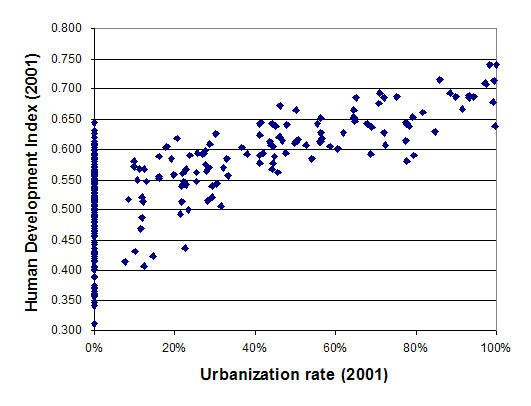
While there is a positive correlation (ρ=0.30) between
population size and the Human Development Index at the municipal
level, there is a much stronger correlation (ρ=0.68) between the
level of urbanization and the Human Development Index (see
Figure 1).
Figure 1: Urbanization and Human Development at the municipal
level
|
