|
The World is
Cooling so the WWF is Turning the Heat On
By Lykke E. Andersen*,
La Paz,
27
October
2008.
Last week, WWF came out with an alarming report "Climate
Change: Faster, Stronger, Sooner: An overview of the climate
science published since the UN IPCC Fourth Assessment Report"
suggesting that Global warming is accelerating beyond IPCC's
forecasts.
That is a
really impressive accomplishment at a time where everything
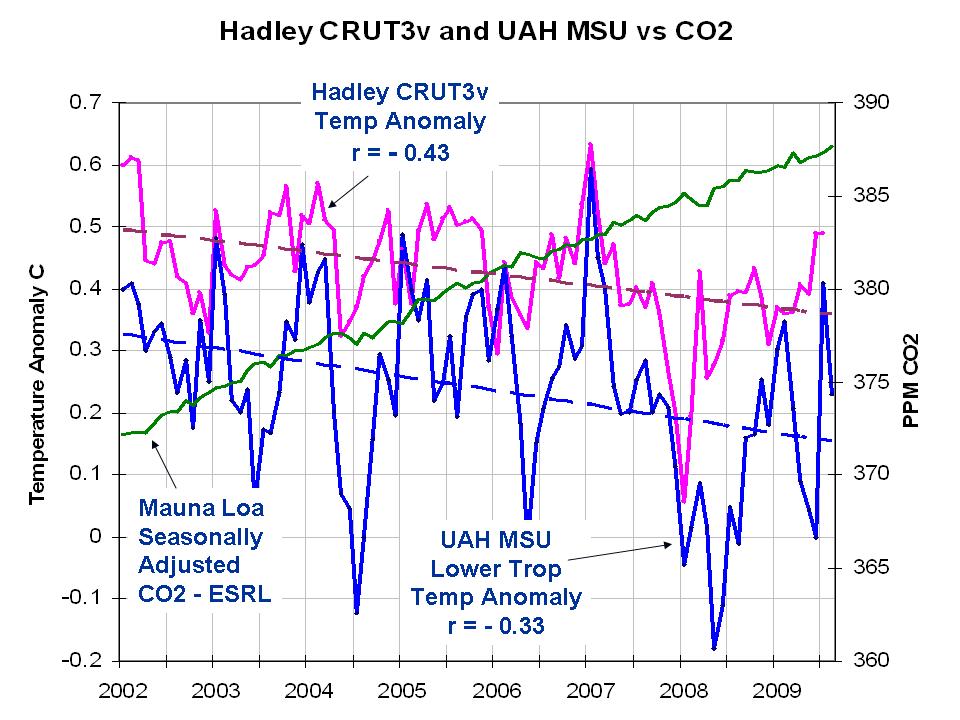
points to the Earth being several years into a cooling cycle
(1),
probably related to the Sun having suddenly changed from
unusually active to unusually quiet (2) and the Pacific Decadal
Oscillation having turned into its negative mode
(3).
Recent climatic
developments notwithstanding, it is theoretically possible that
the new research that has come out since the latest IPCC report
would suggest that IPCC's model parameters should be adjusted,
and that such adjustments would lead to faster, stronger, and
sooner warming.
Only by doing a
very selective review, however, could you come to such a
conclusion. It is quite easy to do a review which would lead to
the opposite conclusion: that warming is going to be weaker and
slower and be delayed for several decades compared to IPCC
forecasts.
This is no
place to do a thorough IPCC-like review of the scientific
literature, but we do have space to review a few recent peer-reviewed
scientific articles, which would definitely lead to adjustments
in the opposite direction of what the WWF report indicates.
One important group of
papers suggest that the effect of solar activity is
underestimated in the 2007 IPCC models. For example, a 2007
paper in the Journal of Geophysical Research by Scafetta and
West (4) finds a very strong correlation between solar activity
and temperature over the last 400 years (see Figure 1 below).
According to their data sets, the Sun would have explained 42%
(+/-20%) of warming since 1950, whereas the IPCC found that the
Sun has contributed virtually nothing to the warming since 1950.
The paper ends with the following conclusion: “If we assume that
the latest temperature and TSI secular reconstructions, WANG2005
and MOBERG05, are accurate, we are forced to conclude that solar
changes significantly alter climate, and that the climate system
responds relatively slowly to such changes with a time constant
between 6 and 12 years. This would suggest that the large-scale
computer models of climate could be significantly improved by
adding additional Sun-climate coupling mechanisms.”
Figure 1: Solar activity (WANG2005) and Global Temperature
Anomalies (MOBERG2005)
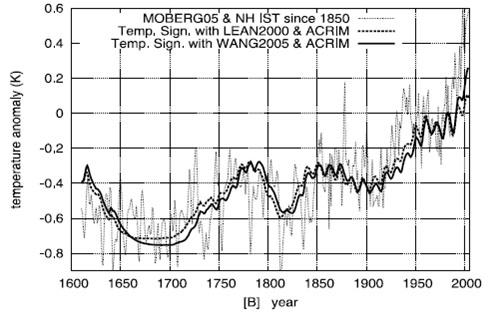
Source:
Scafetta and West (2007).
There is still room
for CO2 to have an effect on temperatures, but the
effect is clearly not as large as if one assumes that the Sun
has had only a negligible effect on Global temperature changes
since 1950.
Another paper by
Schwarz in the same journal (5) also suggests that the currently
used climate sensitivity parameter (how much warming would a
doubling of CO2 cause) is overestimated. His
estimations suggest that a doubling of CO2 would
cause the average global temperature to increase by 1.1 +/-
0.5K, which is much smaller than what the IPCC models currently
operate with (about 3K).
Another group of
papers attack the temperature records that underlie all analysis
and models. McKitrick (2008), for example, find that when
properly excluding effects from local land surface modification,
the estimated 1980-2002 global average temperature trend over
land is reduced by about half (6).
The discussion about
the quality of temperature measurements turns even more animated
for the longer temperature reconstructions based on proxies, and
the question of how warm the Medieval Warm Period was (important
if you want to claim that current warming is unprecedented). A
very recent paper by Craig Loehle in Journal of Climate Change
(7) suggests that trees show a non-linear growth response to
temperatures, and that the assumption of linearity (as applied
in Mann’s hockey-stick) will create a cold-bias in past
temperature reconstructions.
Grudd (2008)
reconstructs arctic temperatures based on a modern tree-ring
analysis from Torneträsk in the northern part of Sweden (within
the Arctic Circle). Here is the key estimated temperature
anomaly series from year 500 to 2004 AD:
 |
Figure 2:
Reconstructed summer (April–August) temperature for the
period AD 500–2004. Panel “a” shows the reconstruction from
ring widths exclusively. Panel “b” shows the ‘‘multi-proxy’’
reconstruction from widths and densities. Both series are
expressed as anomalies (in °C) from their 1951–1970 mean.
The annual data (grey) has been filtered to emphasize
climatic variability on 30- and 100-year timescales (black
curves). Panel “c” shows the difference on multi-decadal (dark
grey) and centennial (light grey) timescales between the two
reconstructions (expressed as an in-between fill of the
curves), with the ‘‘multiproxy’’ reconstruction showing on
average 0.2°C lower temperature estimates.
Source: Grudd (2008). |
Here is an excerpt from the paper: “The late-twentieth
century is not exceptionally warm in the new Torneträsk record:
On decadal-to-century timescales, periods around AD 750, 1000,
1400, and 1750 were all equally warm, or warmer. The warmest
summers in this new reconstruction occur in a 200-year period
centered on AD 1000. A ‘Medieval Warm Period’ is supported by
other paleoclimate evidence from northern Fennoscandia, although
the new tree-ring evidence from Tornetraäsk suggests that this
period was much warmer than previously recognised.” “The new
Torneträsk summer temperature reconstruction shows a trend of
-0.3°C over the last 1,500 years.”
So, while arctic
temperatures have indeed increased during the last century,
there doesn’t seem to be anything unusual about this warming.
The increase looks a lot like the increase that took place about
year 650-750 AD. If you base your climate sensitivity estimation
only on the last 100 years (or on the now debunked hockey-stick
proxy (8)), you would get a high parameter, but if you use new and
more credible proxies for the last 1600 years, you would find
little relationship between CO2 concentrations and
Global temperatures.
Nobody knows how long
the current cooling cycle is going to last (some say 30 years),
but if it lasts just a few more years, then computer models
definitely would have to be revised in order to fix the
increasing discrepancy between predictions and actual climate.
For the purpose of improving climate models, another 10 years of
cooling would definitely be a good thing.
|