|
Bolivians feel poor, but not that poor
By Lykke E. Andersen*,
La Paz,
6 August
2007.
“Poverty, like beauty, lies in the eyes of the beholder.”
Mollie Orshansky
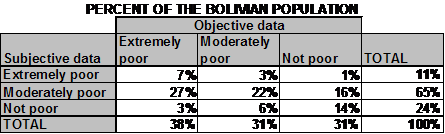
According to official estimates, there are at least 3 million
extremely poor people in Bolivia (about 38% of the total
population). Judging from their very low incomes, they shouldn’t
be able to buy even the minimum basket of subsistence goods. The
majority of people in this group does not have electricity in
the house, and thus none of the convenient inventions that run
on electricity. Still, only a minority of them (18.5%) actually
feel extremely poor (see Table below).
Source:
MECOVI 2003-2004.
In contrast,
more than half of the people who are classified as not
poor, do feel poor.
In total,
less than half of the population is classified in the same
poverty group (extremely poor, moderately poor, not poor) as
they themselves feel they belong to.
This suggests
that our usual monetary measure of poverty does not really
capture the deprivation concept that we would like it to
capture. There are several partial explanations for that:
-
Income
fluctuates a lot from month to month, so last month’s income
is not necessarily a good indicator of permanent (normal)
income. This is particularly true in a country like Bolivia,
where less than 5% of the working age population has a steady,
formal job with a regular salary.
-
People may
judge their poverty relative to others in the country, rather
than in absolute terms. Since Bolivia has astounding levels of
inequality, it is easy to find someone that are definitely
much poorer, but it is also easy to find groups that are
definitely much better off. As a consequence, the majority of
people will consider themselves as belonging to the middle
group, which is also what the table above indicates.
-
People
adapt their needs to the available income. Approximately half
the Bolivian population say that they can get by on less than
30 dollars per month
(1). Of course it could also be the other way around:
people adapt their income to their needs. In any case, there
is a very strong correlation between actual income and
necessary income.
Especially
the last point needs to be understood better. If our policies
and interventions stimulate an increase in needs, then people
will always struggle to make their income strech far enough to
cover their ever increasing needs. When incomes lack behind
needs, people will feel poor, no matter what the level of
income.
Do our
policies create needs? Probably. The terminology we use suggests
so. Poverty measures are completely materialistic, based on a
minimum basket of goods or on unsatisfied basic needs. The
extreme focus on per capita GDP and GDP growth rates also
implicitly weigh the materialistic part of life much more
heavily than all the other aspects that make life worth living.
Are there any
alternatives? Well, we could listen a bit less to the
advertising industry and a bit more to some of the great
philosophers of all time (Gandhi: “Earth provides enough to
satisfy every man's need, but not every man's greed” Nietzsche:”
Possessions are usually diminished by possession”; Thoreau: “It
is preoccupation with possessions, more than anything else, that
prevents us from living freely and nobly” and “That man is the
richest whose pleasures are the cheapest.”
Rather than
imposing the materialistic world view indiscriminately on the
so-called developing countries, we should find out what makes
people happy. Maybe it is freedom, independence, plenty of
quality time in large and close-knit families, playing, dancing,
singing, seeing animals getting born and plants grow up, or just
sitting on the top of a mountain and feel peace settle in every
cell. If so, it is difficult to imagine that the TV, couch and
designer jeans you could buy if you had more money could
possibly compensate for being locked up in an office or factory
every day, away from everything that makes you happy.
(*) Director, Institute for Advanced Development Studies, La
Paz, Bolivia. The author happily receives comments at the
following e-mail:
landersen@inesad.edu.bo.
(1) The subjective poverty module of the Mecovi 2003-2004 asks
for the minimum amount of income the household would need to get
by.
Ó
Institute for Advanced Development Studies 2006. The opinions
expressed in this newsletter are those of the author and do not
necessarily coincide with those of the Institut e
or the sponsors.
If you would like to receive the Monday Morning
Development
Newsletter by e-mail, please
fill in your information here:
|
