|
Living on the Edge: The Perils of Climate Change
By Lykke E. Andersen*,
La Paz,
26
May
2008.
During the
last 100 years, we have experienced four rounds of significant
climate change. In 1912, when Titanic struck an iceberg and
sunk, the New York Times reported that “Prof. Schmidt Warns Us
of an Encroaching Ice Age.” Los Angeles Times the same year:
“Fifth ice age is on the way. Human race will have to fight for
its existence against cold.”
Global
temperatures were indeed unusually cold during the first decades
of the previous century (see Figure 1 below), and ice age
warnings regularly popped up in the media: Los Angeles Times,
1923: “The possibility of another Ice Age already having
started… is admitted by men of first rank in the scientific
world, men specially qualified to speak.” Chicago Tribune, 1923:
“Scientist says Arctic ice will wipe out Canada.”
Figure 1: Instrumental Temperature Record
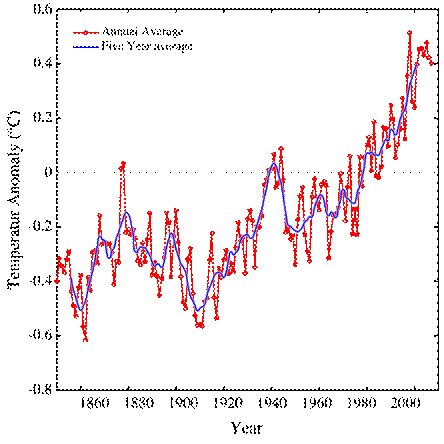
Source:
http://en.wikipedia.org/wiki/Image:Instrumental_Temperature_Record.svg
|
But then
temperatures started increasing for a while, and the media
started warning about warming instead. Los Angeles Times, 1929:
“Most geologists think the world is growing warmer, and that it
will continue to get warmer.” New York Times, 1933 “America in
Longest Warm Spell since 1776. Temperature line records a
25-year rise.” In 1938, British amateur meteorologist G. S.
Callendar made the now familiar claim, in the Quarterly Journal
of the Royal Meteorological Society, that man was responsible
for heating up the planet with carbon dioxide emissions.
Before the
media grew frantic, however, temperatures started falling again.
Although average temperatures fell by less than half a degree
Celsius, both scientists and media found sufficient reason for
doomsday warnings. New York times, 1974: “the facts of the
present climate change are such that the most optimistic experts
would assign near certainty to major crop failure in a decade,”
If policy makers did not take immediate action “mass deaths by
starvation and probably in anarchy and violence” would result.
Newsweek, 1975: “"There are ominous signs that the earth's
weather patterns have begun to change dramatically and that
these changes may portend a drastic decline in food production
-- with serious political implications for just about every
nation on earth.” Nigel Calder, 1975: “The threat of a new ice
age must now stand alongside nuclear war as a likely source of
wholesale death and misery for mankind.” Lowell Ponte, 1976:
“The cooling has already killed hundreds of thousands of people
in poor nations.” If proper measures weren’t taken, then the
cooling would lead to “world famine, world chaos, and probably
world war, and this could all come by the year 2000.”
But by that
time temperatures had already started increasing again, and
during the last couple of decades global warming has replaced
the media’s ice age claims. The results have pretty much stayed
the same, however – the deaths of millions or even billions of
people, widespread devastation and starvation. People apparently
believe that we are living on a knife edge, where everything is
just right (or was just right about 30 years ago), and that any
change is likely to lead to disaster.
Many of the
current claims about the effects of climate change could make
even Malthus turn in his grave: "Billions will die…Human
civilisation will be reduced to a broken rabble ruled by brutal
warlords, and the plague-ridden remainder of the species will
flee the cracked and broken earth to the Arctic, the last
temperate spot, where a few breeding couples will survive”
(James Lovelock in the Daily Telegraph, 2006). “Our ability to
live is what is at stake” (Trailer to the 2006 Al Gore movie “An
Inconvenient Truth”).
The Stern
Review on the Economics of Climate Change states that if global
temperatures increase by more than 5 degrees Celsius “effects
could be catastrophic, but are currently very hard to capture
with current models as temperatures would be so far outside
human experience.” True, global average temperatures have not
been five degrees warmer than now at any time in human history.
Last time it was 5 degrees warmer was during the Eocene Climate
Optimum about 50 million years ago. Still, most people
experience warming of more than 5 degrees every morning between
7 and 9, and somebody who moved from Boston to Florida would
experience a whooping 14.5 degree increase in average
temperatures. The poor students at University of Chicago suffer
average temperature increases of almost 30 degrees Celsius
between January and July every year.
I suspect
that people are probably a whole lot better at dealing with
climate change than they are currently getting credit for.
(*) Director, Institute for Advanced Development Studies, La
Paz, Bolivia. The author happily receives comments at the
following e-mail:
landersen@inesad.edu.bo.
(1) The main
source for this article: R. Warren Anderson (2006) “Fire
and Ice”, Business and Media Institute. The summary
of the climate change debate by Michael Goodfellow: “Global
Warming: Our Story So Far” is also very useful.
Ó
Institute for Advanced Development Studies 200 8.
The opinions expressed in this Newsletter are those of the
author, and do not necessarily reflect those of the Institute or
of the sponsors.
If you would like to receive the Monday Morning
Development
Newsletter by e-mail, please
fill in your information here:
|


