|
Social Mobility in Bolivia is finally improving - and now I can
prove it!
By Lykke E. Andersen*,
La Paz,
25 January
2010.
Back in 2006, I published a newsletter postulating that “Social
Mobility in Bolivia is Finally Improving!”
The article was based on casual observations (mostly Evo Morales
becoming the President of Bolivia and a former maid becoming the
Minister of Justice). Recently, however, I have made a formal,
quantitative estimation of the changes in social mobility in all
of Bolivia between 1997 and 2007, and the results are nothing
short of spectacular! (1).
Social Mobility is an elusive concept that is difficult to
estimate quantitatively, but a convenient methodology has been
developed to estimate a Social Mobility Index based on
information commonly available in standard household surveys.
The methodology is based on the simple idea that social mobility
is low if family background is important for a child’s future,
while social mobility is high if all children have equal
opportunities despite different family backgrounds
(1).
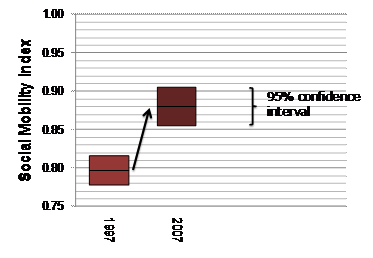
Figure 1 summarizes the changes in the Social Mobility Index
between 1997 and 2007
for all teenagers in Bolivia.
There is a very important and statistically significant increase
in social mobility, which brings us from one of the lowest
levels in Latin America in 1997 to a very high level in 2007
(1).
Figure 1: Changes in the Social Mobility Index for different
groups
of teenagers in Bolivia, 1997-2007 (with 95% confidence
intervals).
Source:
Andersen (2009).
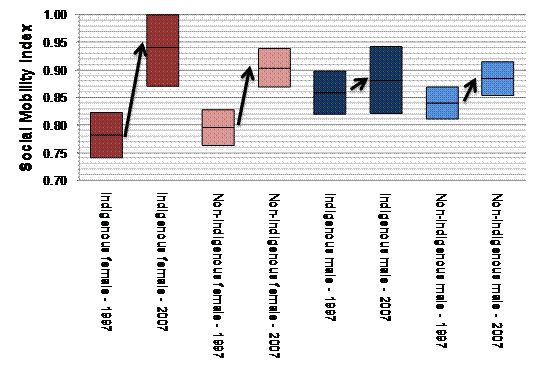
An analysis by sub-groups indicates that it is the improvements
in mobility among indigenous and non-indigenous girls that are
responsible for this improvement, while the improvements among
young males are not statistically significant (see Figure 2).
Figure 2: Changes in the Social Mobility Index for different
groups of teenagers in Bolivia,
1997-2007 (with 95% confidence intervals).
Source:
Andersen (2009).
This improvement is very good news, as low social mobility in
Bolivia has for centuries constituted a formidable barrier to
development, resulting in high and persistent poverty rates and
low economic growth (e.g. Andersen, 2001
(2); Mercado et al, 2002 (3);
Andersen, 2003 (4); Azevedo & Bouillon,
2009 (5)).
Some of the improvement in social mobility is likely due
to a change in perceptions about social mobility. Rural,
indigenous teenagers
(especially
girls)
frequently dropped out of school in the past because they did
not perceive any opportunities for taking advantage of formal
schooling. Now, on the other hand, they see people of similarly
modest backgrounds reaching very high and prestigious positions.
Such real life examples of social mobility can cause mental
barriers to tumble down, and motivate teenagers to study, work
and try to improve their lot. And simply by trying, they will
dramatically improve their possibilities of succeeding, as well
as contribute to the economic development of the country.
But part of the improvement is also due to the enormous efforts
made by both the current and previous governments, with help
from the international cooperation, to increase the supply of
education facilities and to reduce obstacles against school
attendance. The benefits of all these investments in education
are finally, thankfully, beginning to show, and it looks like
Bolivia may have finally escaped the low mobility – low growth
trap and is heading for a high mobility – high growth
equilibrium.
This
constitutes
a profound and very important structural change.
Perhaps I am an incurable optimist, but
it
might just be the change necessary to take Bolivia out of the
poverty trap where it has been stuck for so long. It is
certainly the biggest and most important step forward I have
ever seen in any society in such a short time.
Related articles:
-
Social Mobility in Bolivia is Finally
Improving!
- The Dynamics Behind Inequality
|
