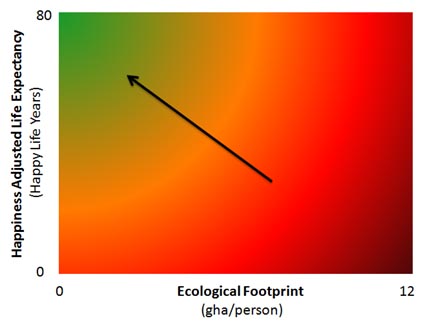
A compass is a direction finding instrument. The classic
magnetic compass indicates where north is and helps us
choose in which direction to walk if we happen to be lost in
a wilderness area. However, we need direction in so many
more ways than that. Every choice we make implies choosing
one direction over another, and the better direction finding
instruments we have, the better choices we will make. This
holds at all levels from the personal level to the country
level, and in all areas of life from driving to choosing
where to study. This article is about direction finding at
the community or country level.
In Bolivia, the stated goal is “living well in harmony with
nature.” This is a very sensible goal aiming at securing
human well-being without destroying the natural assets on
which all life depends. But what exactly do we mean by
living well in harmony with nature? How do we know if we are
doing it? And, if we are not doing it, how do we know which
policies might move us in the right direction? In order to
answer these crucial questions, we need indicators that can
serve as a compass.
We can split the concept of “living well in harmony with
nature” into its two dimensions, which facilitates analysis
and measurement. In one dimension, we would have the “living
well” aspect, and in the other dimension, we would measure “harmony
with nature.”
Living well can either be measured objectively (usually by
income, basic needs or asset indicators) or subjectively (capturing
the level of life-satisfaction or happiness). Subjective and
objective indicators are highly correlated in poor countries,
but the correlation tends to break down as people become
richer. In any case, being happy and healthy seems to be
more directly related to the goal of living well, while
income, electricity and education may be thought of as means
to achieve that goal.
Thus, ideally, our indicator of living well should measure
the degree to which we live happy and healthy lives. The
Happy Planet Index (1) proposes to use “happiness adjusted
life expectancy” as a summary indicator. It is calculated as
life expectancy multiplied by subjective well-being (as
measured on a scale from 0 to 1), and the units are “Happy
Life Years.” In the case of Bolivia, life expectancy is
about 65 years and life satisfaction is about 0.65, so the
happiness adjusted life expectancy is 42 Happy Life Years.
The highest level of human well-being at the country level
is achieved in Costa Rica, where life expectancy is 79 years
and life satisfaction is 0.85, implying an average human
well-being of 76 Happy Life Years. At the other extreme we
find Zimbabwe, with a life expectancy of 41 years and life
satisfaction of 0.28, implying an average level of human
well-being of only 17 Happy Life Years.
As for any indicator, data is needed to construct this one,
and while several large surveys have been carried out (2),
subjective well-being is not yet a standard question in
household surveys and censuses. It should be, though, as it
is central to our goal of living well and it takes just one
simple question:
All things considered, how satisfied are you with your life
as a whole these days?
Responses are recorded on numerical scales, typically from 0
to 10, where 0 is dissatisfied and 10 is satisfied.
I would strongly recommend that this question is included in
all future household surveys in Bolivia, as well as in the
next census, because if it is not, we are going to have a
compass without a needle.
As to the “harmony in nature” dimension, it is easier to
measure in the opposite direction, as the amount of “environmental
damage.” In Bolivia, most people have very low environmental
impacts, because they consume few resources, use little
energy, and generate modest amounts of waste. Thus, they can
be said to live in harmony with nature. However, a small
percentage of the population pulls up average environmental
impacts. The uncontrolled burning of several hundred
thousand hectares of forest every year and the thoughtless
contamination of precious water sources cannot possibly be
considered “harmony with nature.”
The Happy Planet Index proposes to use the concept “Ecological
Footprint” as a way of aggregating the many different types
of environmental impacts into one simple measure, which
indicates how many hectares of bio-productive area a person
“uses.”
The area of biologically productive land and water on Earth
is approximately 11.9 billion hectares. Not all areas are
equally productive, but through conversion factors, they can
be standardized into average global hectares (gha). With a
World population of 6.6 billion people, the available
bio-capacity is about 1.8 gha per person. Thus, we might say
that people who use less than 1.8 gha live in harmony with
nature, while people who use more than their fair share do
not.
Currently, Bolivians on average use about 2.1 gha/person, so
we use more than our fair share of the World’s
bio-productive area. However, Bolivia has more
bio-productive area per person than any other country in the
World, so we are living well within our own bio-productive
capacity. Thus, in the “harmony with nature” dimension, we
are doing reasonably well (except for the 5% of the
population (many of them foreigners) who are causing 95% of
the environmental damage).
However, in the “living well” dimension, we are not doing
very well. Indeed, according to one of the World Happiness
Maps, Bolivia is right at the bottom, much below Zimbabwe
and war torn Iraq (3). This is very disappointing, and hopefully
not entirely accurate. However, it is clear that we need to
make progress in the well-being dimension, and for that to
happen, we need to better understand what makes Bolivians
happy.