The development community has for years been heralding
microcredit as a means to escape poverty, but some very
simple math suggests that we need to be cautious about
pushing it too much.
To do this simple math, let’s compare the life-stories of
two fictional boys who are both born poor. Let’s call them
Micky and Savvy. Both work part time from age 10 earning 1
dollar per day, but they live at home with their parents,
who provide for their basic needs. Micky spends his hard
earned 7 dollars every week-end with his friends, while
Savvy saves them and manages to invest his modest funds at
an average real rate of return of 10% per year (mostly by
lending money to needy friends and relatives).
By the age of 20, they both move away from home and start
working full-time. Paid work only pays a miserable 3 dollars
per day, so Micky decides to start his own business instead.
He borrows 6500 dollars from a microfinance institution in
order to buy the necessary equipment to run his business (for
example a used car to become a taxi driver), and this allows
him to earn twice as much as a paid worker for the next 10
years (i.e. 6 dollars per day instead of 3, from age 20 to
age 30). The real interest rate charged by the microfinance
institution is 30% per year, so Micky wisely decides to
spend as little money as possible on himself (2 dollars per
day, which is right at the poverty line) and uses the
remaining 4 dollars per day to pay back his loan.
In contrast, Savvy does not have access to credit, so he has
to accept the job that pays the miserable 3 dollars per day.
Like Micky, he keeps his expenses low at 2 dollars per day,
which leaves 1 dollar per day in savings, which he manages
to invest at 10% per year, just as he has been doing since
he was 10 years old.
By the age of 30, Micky has handed over all his savings
during 10 years to the microfinance institution (14,600
dollars – more than twice the amount he borrowed and 2/3 of
everything he earned), but his debt has only grown, now
amounting to about 8,700 dollars. His equipment has worn out,
so he can no longer earn 6 dollars per day, and instead has
to take a regular job paying 3 dollars per day. He is now
heavily indebted, and has to reduce his expenditures to an
absolute minimum (1 dollar per day, which is at the extreme
poverty line). The remaining 2 dollars per day he pays to
the microfinance institution.
In contrast, Savvy has been building up his savings one
dollar per day, and by the age of 30 he is worth more than
20,000 dollars, so he decides it is time to improve his
living standards (he doubles his daily expenditures from 2
to 4 dollars). He is still only earning 3 dollars per day as
a regular, unskilled worker, but the returns on his small
investments allow the additional expenditure without
reducing his capital.
Unless Micky declares bankruptcy or otherwise defaults on
his debt, his debt will accumulate for the rest of his life,
reaching a staggering 20 million dollars by retirement age
(60 years). In contrast, Savvy can keep increasing his
expenditures regularly, reaching levels far above the
poverty level and far above his income level; and still see
his net wealth increasing. Figure 1 compares the net wealth
of Micky and Savvy over time under the abovementioned
assumptions.
Figure 1: Net wealth of Micky and Savvy, from age 10 to age
60
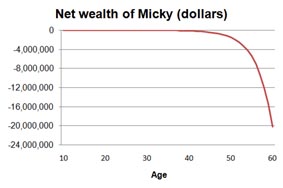
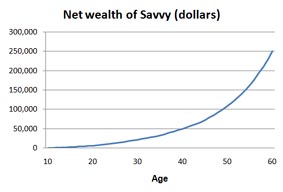
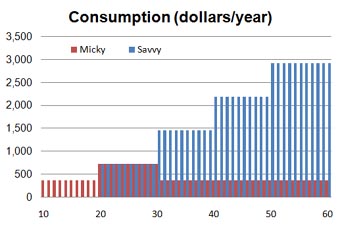
Figure 2 compares the annual consumption of Micky and Savvy.
Micky, due to his microcredit loan, has been living in
extreme poverty most of his life, with an accumulated
expenditure of only 23 thousand dollars during the 50 years.
Savvy, although he has earned only 48 thousand dollars in
accumulated labor income, was able to sustain accumulated
consumption of 76 thousand dollars and still has savings
worth a quarter of a million dollars.
Figure 2: Annual consumption of Micky and Savvy, from age 10
to age 60
A lousy little loan, which seemed like a good idea at the
time, doomed Micky to a life in extreme poverty and heavy
indebtedness, while Savvy, who couldn’t get a loan, did very
well. When real interest rates are above a few percent, it
makes a huge difference whether you are on the borrowing
side or the lending side of the credit transaction. And in
the world of poor people and microcredits, real interest
rates are always in the two digit range.
In some cases it makes sense to borrow money, even at 30%
interest. For example, if you borrow money to buy goods that
you are sure to sell very quickly, this may allow you to
take advantage of business opportunities that you would
otherwise be excluded from. This is why most micro credit is
used by the informal commerce sector. For productive
activities, microcredit rarely makes sense, and for housing
and consumption purposes it is a distinctly bad idea.
Microfinance institutions will of course never let debt grow
into the millions. Instead they would confiscate the few
assets the borrower has, including even his home. In case of
group credit, they may also confiscate assets from other
borrowers in the group, if these are unable to pay the debt.
The devastating consequences of not complying with the
monthly payments to a microcredit institution make defaults
relatively rare, as borrowers will do anything in their
power to comply, even borrowing informally at an even higher
rate.


