
Would REDD work in Bolivia?
By Lykke E. Andersen*, La Paz, 28 March 2011.
|
In Bolivia, agricultural land generates on average three
times as much GDP per hectare as standing forest (1), which
is one of the reasons why the Bolivian government largely
ignores the quarter million hectares of illegal
deforestation that occurs every year.
However, forests provide many valuable functions that are
not currently included in GDP (e.g. habitat for thousands of
plant and animal species; carbon storage to protect against
climate change; water capture, storage and cleansing for a
cleaner and more stable water flow; recreational and
aesthetic values; etc.). As long as all these benefits are
not taken into account, natural forests stand little chance
against other land uses.
The REDD mechanism intends to tip the balance slightly in
favor of forests by recognizing at least one of the values
of forest, namely carbon storage. The idea behind REDD is
that rich countries would reward poor countries if they
manage to reduce carbon emissions from deforestation and
forest degradation (below what it would have been in the
absence of this mechanism). Any mechanism that promises to
simultaneously reduce rural poverty and environmental
degradation (with strict safeguards to secure that nobody is
harmed by the mechanism) deserves a serious analysis.
The minimum requirements for REDD to work for a poor country
are the following: 1) substantial amounts of forests, 2)
substantial deforestation, and 3) relatively low opportunity
costs of forested land. Bolivia qualifies on all three
accounts, with more than 50 million hectares of forest, more
than 300,000 hectares of annual deforestation, and typical
land prices of $300-600 per hectare (compared to $3,000 in
Brazil and $30,000 in the US). With this evident potential,
Bolivia has been invited to receive funds to prepare for
REDD by both the UN (UN-REDD) and the World Bank (FCPF),
with support from several bilateral donors (especially
Germany, Denmark and the Netherlands).
However, even if the mechanism makes sense economically (it
could bring in billions of dollars for rural development),
it also has to be politically acceptable. Whether it is
politically acceptable depends a lot on who would benefit
from the mechanism, and who would lose.
The most influential parts of the government has intuitively
rejected REDD, probably because they suspect that the
mechanism would benefit mostly large landowners in the
forested Bolivian lowlands, which belong mostly to the
opposition.
While this is a very sensible intuition, it is worth doing a
more careful empirical analysis of the potential winners and
losers from REDD. In order to do this analysis we have
developed a neat tool at Conservation International called
OSIRIS-Bolivia (Open Source Impacts of REDD Incentives
Spreadsheet for Bolivia). The tool divides Bolivia into
roughly 120,000 pixels of 3 by 3 km, and provides
information on forest cover, deforestation rates,
opportunity costs, and all the relevant geographical and
socio-economic conditions for each pixel necessary to
estimate the effect of REDD under different circumstances
(2). Being a little bit outdated due to data limitations,
OSIRIS simulates the effects REDD would have caused if the
mechanism had been fully working during the period
2001-2005.
Our very first simulation was run to satisfy my curiosity
about where REDD might work in Bolivia, and the results look
as presented in Map 1:
Map 1:
Estimated Gross per capita REDD revenues (USD), by
municipality
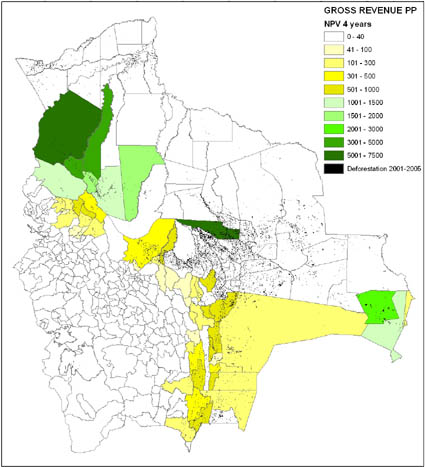
Source: Map
elaborated by Juan Carlos Ledezma based on results from
OSIRIS-Bolivia.
Notes: Net
present value in USD over a 4 year period, assuming a price
of $5/tCO2,
with
compensation made at the municipal level, and the reference
level set to Business as Usual.
All the white municipalities in the map either have no
significant forest (the highlands of Bolivia) or wouldn’t be
interested in participating in a REDD mechanism because
agriculture is much more profitable (most of Santa Cruz and
Pando). The green and yellow municipalities are the ones who
might potentially benefit from a REDD mechanism (at the
price of $5/tCO2; if
the price were higher more lowland municipalities would want
to participate). Especially the green municipalities would
experience very significant gains from REDD, easily doubling
per capita incomes. The yellow ones would experience more
modest, but still significant, gains.
The rural population inhabiting the colored municipalities
represents one third of the total rural population in the
country, so two thirds of the rural population wouldn’t
receive any benefits. Even with the generous assumption that
REDD benefits are distributed evenly across all rural
inhabitants in each municipality, 10% of the rural
population in Bolivia would receive 90% of the REDD benefits
(the Gini coefficient of gross REDD revenues is a whooping
0.922). Approximately 26 municipalities would receive 90% of
gross REDD revenues, and only 3 of these municipalities
would be among the poorest half of municipalities (as
measured by the Human Development Index).
So, with the current focus on compensating reduced
deforestation, REDD would tend to benefit a small,
relatively rich, rural minority.
Although the REDD mechanism supposedly has built-in
safeguards to assure that nobody will be harmed by the
mechanism, this is not true according to the OSIRIS
simulation.
With an international price of $5/tCO2 (a
conservative estimate), and a 20% loss to bureaucracy (also
conservative), the REDD mechanism would cause a 22%
reduction in deforestation in Bolivia, which is very
respectable. However, the reduction in deforestation would
be directly associated with a reduction in agricultural
production, and as we have all recently experienced, the
price of food products is very sensitive to reductions in
agricultural production both in Bolivia and in the rest of
the world. Thus, according to OSIRIS, a 22% reduction in
deforestation would cause a 69% increase in the domestic
price of food products. This means that the entire urban
population, and especially the poorest, would suffer
significantly from the REDD mechanism due to higher food
prices. The urban population constitutes more than two
thirds of voters, and any political leader would be
reluctant to implement a measure harming the majority of
voters. In addition, the inflationary pressure this would
cause would also be politically unacceptable in Bolivia.
So, the Government’s intuitive rejection of REDD does indeed
seem justified. And there are many more problems with REDD
than the ones mentioned above.
What the Government doesn’t realize is that there are
solutions to all these problems, which would vastly improve
the political acceptability of the mechanism and allow
Bolivia to receive billions of dollars in compensation for
reduced deforestation.
Presenting the solutions to all the problems of REDD is
beyond the scope of this short newsletter, but a first step
towards finding solutions is at least to be explicit about
the problems. Nothing is gained by glossing over the
problems and pretending that REDD is an easy and cheap way
to combat climate change, because it is not. Likewise,
nothing is gained by just rejecting the mechanism on
philosophical grounds. The only way forward is to carefully
analyze the problems and devise practical solutions. REDD is
still in the design phase, and this is the time to tackle
potential problems. If REDD is prematurely and uncritically
implemented, it will fail miserably, and a great opportunity
for saving at least some of the World’s remaining natural
forests will be lost.
(*) Scientific
Manager, Conservation International - Bolivia. The author
happily receives comments at:landersen@conservation.org.
(1) Jemio, L. C. & L. E. Andersen (2010) "Insights
from Bolivia's Green National Accounts"
Institute for Advanced Develoment Studies, Development
Research Working Paper No. 15/2010. December.
(2) OSIRIS-Bolivia is still under development, but will soon
be made freely available for anyone who wants to explore the
potential effects of REDD in Bolivia.
(c)
Institute for Advanced Development Studies 2011. Feel free
to circulate in its original form. Past issues can be found
at www.inesad.edu.bo/mmblog.htm .
The opinions expressed in this newsletters are those of the
author and do not necessarily coincide with those of the
Institute or of the sponsors.
If you would like to receive the Monday Morning
Development
Newsletter by e-mail, please
fill in your information here:
|

