Institute for Advanced Development Studies

- removing critical obstacles to sustainable development
 

  Mission      Members      MM Blog      Papers      Projects      Courses      Internships      Sponsors      Contact us      Check mail      Spanish   


             Monday Morning Development Newsletter


Natural resource rents and taxes: Insights from Bolivia's Green National Accounts
By Lykke Andersen*, La Paz, 27 December 2010


Green National Accounting (1) corrects one of the flaws in conventional national accounting, which is ignoring the important role of nature as a source of inputs into production processes.

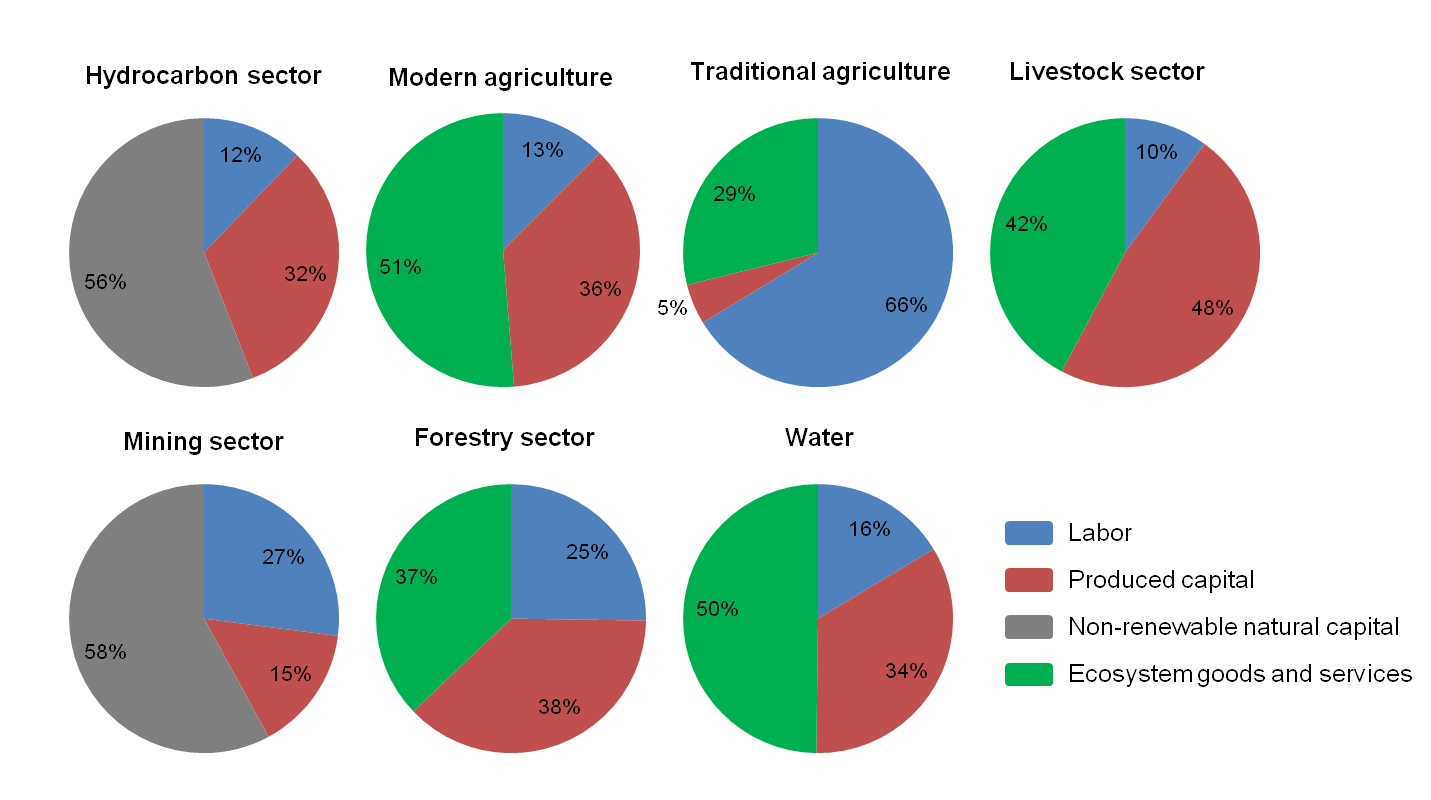
In some sectors these environmental inputs are very important (e.g. forestry, farming and fishing), while in other sectors they play a minimal role (e.g. banking, commerce and education). In each sector they interact with the two other conventional production factors, labor and capital, to produce the total GDP for the sector, but the proportions are different for each sector (see Figure 1 for the sectors with a significant environmental component):

Figure 1: The relative contribution of different factors of production to sector GDP, Bolivia 2008
Source:
 Authors elaboration based on (2).

The contribution of non-renewable natural capital and ecosystem services (the grey and green slices) are called natural resource rents. The benefits from these rents should theoretically go to the owner of the corresponding productive asset, which according to the Bolivian Constitution would be the State. The State should try to recover these rents in the form of royalties or taxes, because otherwise producers would capture these rents in addition to the normal, fair payments for the labor and capital they have contributed.

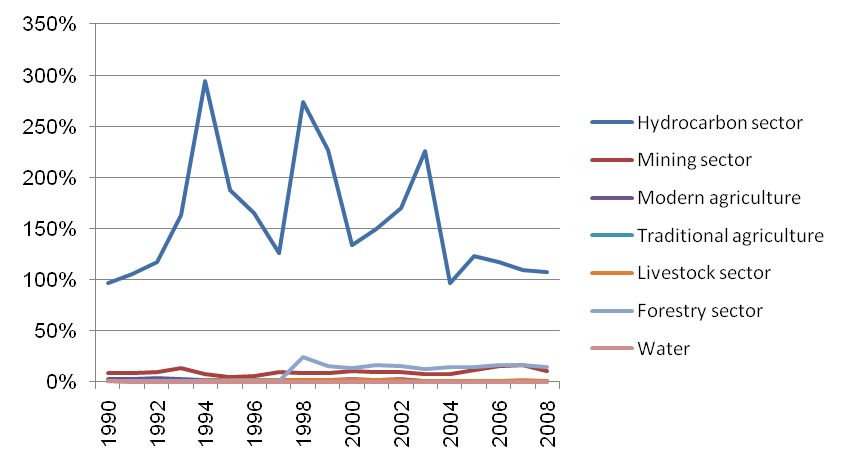
The Green National Accounts allow us to judge whether the State manages to recover the resource rents in the form of royalties or taxes in each sector. Figure 2 shows the percentage of natural resource rents which is paid in producer taxes in each sector between 1990 and 2008. The aim should be to recover close to 100% of the natural resource rents in each sector, but the figure shows that this is only accomplished in the hydrocarbon sector. Indeed, in most years, the State manages to capture considerably more than 100% of the natural resource rents in the hydrocarbon sector, suggesting that the production companies (state and private) are not getting fairly compensated for the labor and capital invested. This could affect long-term sustainability of the hydrocarbon sector, as the affected companies will be reluctant to make the necessary investments.

Since 2004, the recovery of resource rents in the hydrocarbon sector has been quite close to the target of 100% and the percentage has been relatively stable compared to previous periods with wild fluctuations.  

Figure 2: Producer taxes as percent of natural resource rents in each sector, 1990 - 2008
Source:
 Authors elaboration based on (2).

In all the remaining sectors, the State is not good at recovering the natural resource rents. In the mining sector, for example, the State only manages to recover about 10%, indicating that producers obtain exceptional profits in this sector. The forestry sector paid less than 1% of resource rents to the State until 1997, after which a new forestry law managed to increase this percentage to about 16%, which is still far from the target of 100%.

Agriculture and livestock sectors still only pay approximately 1% of the natural resource rents, suggesting that the State is subsidizing producers in these sectors, allowing them to get profits over and above what is warranted by the amount of labor and capital they are putting into the production. Such a subsidy would tend to encourage the expansion of the agricultural frontier at the expense of natural forests.

Green National Accounts are great for identifying rents that can be taxed without discouraging hard work and productive investment, and they are particularly useful for assessing the correct level of taxes/royalties in natural resource dependent sectors. The Green National Accounts for Bolivia suggest that producers in the mining, agriculture, livestock and forestry sectors are benefitting unfairly from free access to natural resources that supposedly belong to all Bolivians. This implies that the Government of Bolivia would be entirely justified in increasing taxes on mining and modern agriculture and in cracking down severely on illegal logging and deforestation.


Related articles:

 Economía y Medioambiente
Aesop, Golden Eggs and Ecosystem Services     
Is Bolivia's development model sustainable? Insights from the Green National Accounts                        
                                                                                         

Sponsored by:        

(*) Scientific Manager, Conservation International - Bolivia. The author happily receives comments at the following address:  landersen@conservation.org .
(1) See the 2003 handbook of green accounting by the United States here: “System for integrated Environmental and Economic Accounting” (SEEA).
(2) 
Jemio, L. C. (2010) “Cuentas Medioambientales para Bolivia, 1990-2010.” Development Research Working Paper No. 14/2010. Institute for Advanced Development Studies, La Paz, Bolivia. December.


(c) Institute for Advanced Development Studies 2010. Feel free to circulate in its original form. Past issues can be found at www.inesad.edu.bo/mmblog.htm . The opinions expressed in this newsletters are those of the author and do not necessarily coincide with those of the Institute or of the sponsors. 


If you would like to receive the Monday Morning Development Newsletter by e-mail, please fill in your information here:

Name:

E-mail: